
SEED SELF SERVICE
Self-service kiosks for Ohio dispensaries
Shorter lines, bigger carts, and loyalty sign-ups that happen on their own — kiosks synced live to your POS. Ohio flipped to adult-use in 2024, and its converted medical stores now handle a much bigger crowd with the same square footage.
KIOSKS IN OHIO
Built for the room Ohio actually has
Regulars want out in five minutes; first-timers want to read without being hovered over. Kiosks serve both: an express lane for the shoppers who know their order, and pressure-free browsing for the ones still deciding — sort, filter, and read at their own pace, which matters in a store where the products live behind glass. Checkout asks for three things — first name, last name, phone number — and the order lands in your POS.
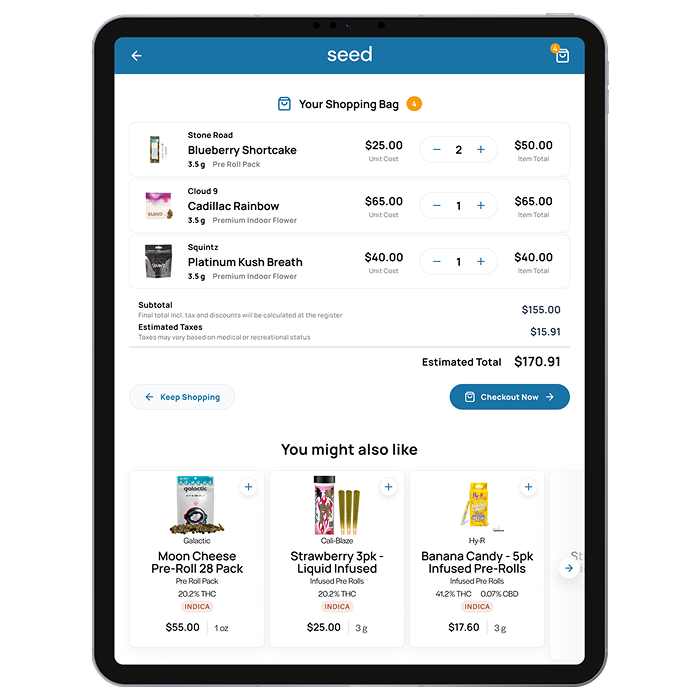
40% higher average order value
Nobody explores add-ons while a line forms behind them. Kiosks let shoppers browse without the clock — and our recommendation engine suggests relevant products at the moments that matter. Less rush, bigger carts.
150% more loyalty sign-ups
Enrollment happens at the kiosk, mid-order, with no extra step at the counter — which is why stores see dramatically more sign-ups than on standard kiosks. Loyalty grows while the line moves.
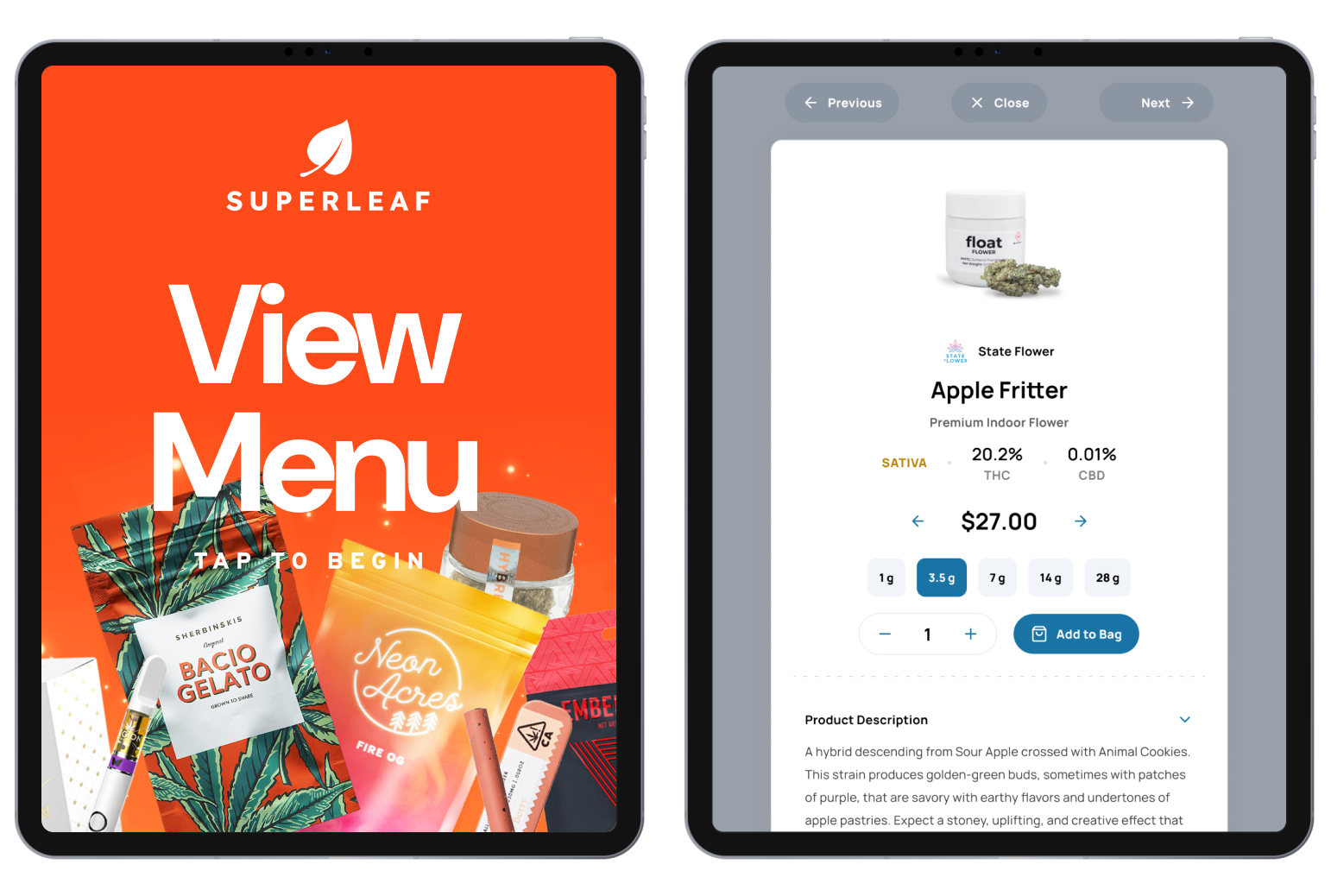
Your brand on the glass, not ours
Kiosks are fully white-label: your colors, your logo, your voice. And checkout asks shoppers for exactly three things — first name, last name, phone number — because sixteen form fields is how you end a line-skipping express lane.
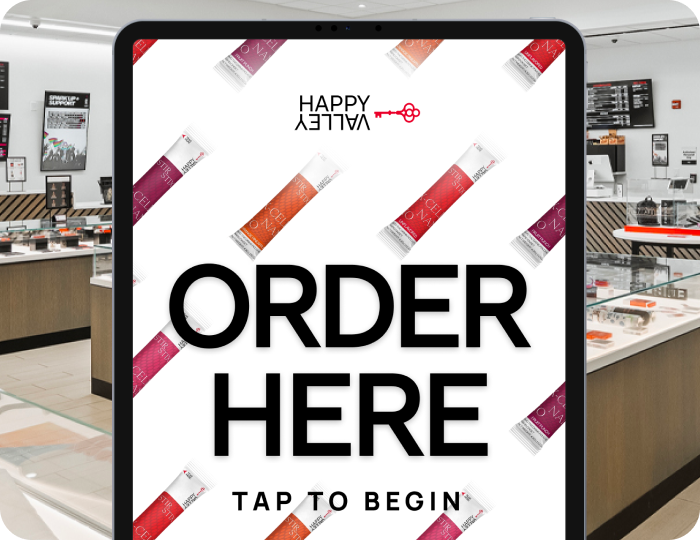
“Happy Valley has reported up to 26% larger order sizes on Seed, compared to traditional sales.”
Dispensaries with self-service kiosks report:
Decreased Time Per Transaction
Increased Cart Sizes and Sales of Featured Products
Reduction of Average Staffing Costs
Customer Satisfaction of the Modern Experience
Trusted by dispensaries across the country, from MSOs to mom-and-pops










IN-STORE SCREEN RULES · OHIO
What you can show on screens in Ohio
A single Division of Cannabis Control rule, effective January 15, 2026, now governs advertising for medical, adult-use, and dual-use dispensaries and, per the Division, replaces the former Board of Pharmacy rule and its $100-per-advertisement fee, although that older rule still appears on the state code site. In-store screens are treated as advertising: no health-related statements of any kind on menus (the Division lists words like "relaxing," "sleepy," and "pain relief"), no depictions of consumption, no content attractive to children, product names must match the registered names, and any depiction of packaging must show the DCC seal and THC symbol. Since March 20, 2026, the statute requires names, logos, signs, and materials to be submitted to the Division for approval, deemed approved after 21 business days, and the Division reviews advertising through its eLicense portal; whether every menu layout must be submitted, and whether a fee applies, is not settled. Exterior menu signs and billboards are prohibited, illuminated wayfinding signs are allowed, cannabis in the retail area must not be visible from outside, free cannabis is prohibited, and discounts may be shown only under a Division-approved written discount policy.
Applies to: medical, adult-use, and dual-use dispensaries, under one DCC rule since January 15, 2026. Regulator: Ohio Department of Commerce, Division of Cannabis Control (DCC).
- One Division rule covers advertising for cannabis "whether medical or adult-use," and the Division states it replaces the former Board of Pharmacy advertising rule. “OAC 1301:18-4-22 replaces OAC 3796:5-7-01 and 3796:6-3-24.” (OAC 1301:18-4-22(B); DCC newsletter, January 15, 2026)
- Menus are advertising: no health-related statement anywhere, including menus. The Division lists "sleep or sleepy," "relaxing," "energy," "pain relief," "calming," and onset or duration references as examples. “No advertising, whether on a package, menu, website, or other medium, may contain a health-related statement.” (DCC Advertising Guidance (January 2026); OAC 1301:18-4-22(A)(9))
- The statute bars any advertisement suggesting adult-use marijuana has health or therapeutic benefits. (ORC 3796.32(E))
- No content attractive to children; no cartoon, fictional, or pop-culture characters aimed at youth; no depiction of consumption; nothing encouraging excessive use or intoxication. (OAC 1301:18-4-22(A)(3)-(6))
- Product names on screens must match the registered name; no slang. (OAC 1301:18-4-22(A)(7))
- Since March 20, 2026, names, logos, signs, and materials must be submitted to and approved by the Division, deemed approved if not denied within 21 business days; the Division reviews advertising applications through eLicense. Whether each in-store menu layout must be submitted, and whether a fee applies, is not settled. “No person shall advertise medical or adult-use marijuana using names, logos, signs, or materials that have not been submitted to, and approved by, the division” (ORC 3796.32(G))
- The former Board of Pharmacy rule required submission and a $100 fee per advertisement; the Division says it is replaced, but it still appears un-rescinded on the state code site. (OAC 3796:6-3-24(C); OAC 3796:6-5-01(C))
- Exterior signage is limited to wayfinding on the parcel or a monument sign; exterior menu signs and billboards are prohibited; illuminated signs are now permitted. “Exterior menu signs are prohibited.” (DCC Advertising Guidance (January 2026); OAC 1301:18-4-22(E))
- Cannabis in the retail area’s secure zone must not be visible from outside the facility. (OAC 1301:18-8-02(E)(2)(c)(ii))
- The DCC seal and THC symbol are not required on every ad or menu tile, but any depiction of packaging or labeling on a menu must show them accurately. “The DCC seal and THC symbol are required to be included accurately on any advertising depictions of cannabis packaging or labeling, such as dispensary menus.” (DCC newsletter, January 15, 2026; OAC 1301:18-4-22(H)-(J))
- No free cannabis; discounts only under a Division-approved written discount policy with parity for registered patients; loyalty programs may not discount cannabis. “A dispensary may only offer discounts in accordance with a written discount policy that has been submitted to and approved by the Division” (DCC Discounts and Loyalty Programs Guidance (March 2026); OAC 1301:18-8-11)
- The 500-foot buffer from schools, churches, libraries, playgrounds, and parks does not apply to signage on the licensee’s facility. No required consumer warning text on advertisements, and no rule on in-store video or moving signs, was found. (ORC 3796.32(F)(2); OAC 1301:18-4-22)
Potency on menus: No rule found for menus or screens; potency is a labeling matter.
Where the rule is "keep it accurate," a menu that reads from the POS does the work: sold-out products drop off on their own and the price on the wall is the price at the register. Where the rule is about content, the layout and the campaign are yours to keep inside the lines.
Sources (7)
- OAC 1301:18-4-22 — DCC advertising rule for all licensees, effective January 15, 2026
- ORC 3796.32 — statutory advertising restrictions and pre-approval, effective March 20, 2026
- DCC Advertising Guidance (January 2026) — health-related statements on menus, signage, seal and symbol, eLicense review
- DCC newsletter, January 15, 2026 — new rule replaces the Board of Pharmacy rules
- DCC Discounts and Loyalty Programs Guidance (March 2026) — discount policy approval; no free cannabis
- OAC 3796:6-3-24; 3796:6-5-01 — former Board of Pharmacy medical advertising rule and fee
- OAC 1301:18-8-02 — retail area: cannabis not visible from outside
Summary for kiosks operators, reviewed against the primary sources on September 24, 2026. Not legal advice. Rules change; confirm with Ohio Department of Commerce, Division of Cannabis Control (DCC) before a campaign goes live. Every state: in-store screen rules by state.
Kiosks in Ohio: questions, answered
Do Ohio dispensaries use self-service kiosks?
Does a Seed kiosk work with my POS?
Will the kiosk say Seed on it?
Will self-service replace my budtenders?
What does a kiosk cost?
How fast can my store go live?
What can a Ohio dispensary show on its in-store screens?
Screens beyond the kiosk: TV menus for Ohio dispensaries. Still building the store? Start with how to open a dispensary in Ohio.

GET STARTED
Put a kiosk to work in your Ohio store.
Book a quick call — bring your current setup (or the line you wish was shorter) and we'll show Seed running on your live menu.