
SEED TV MENUS
TV menus for New York dispensaries
Menus that never lie: prices, products, and stock synced from your POS, so the wall always matches the register — and nobody spends their morning retyping it.
TV MENUS IN NEW YORK
The menu is the store
New York’s market is scaling fast, and the stores winning it treat the room itself — the line, the menu, the wait — as the product. The menu is the most-read thing in the store. When it’s wrong — a sold-out SKU still up, a stale price — your budtenders spend the day apologizing for it. When it’s synced, they sell.
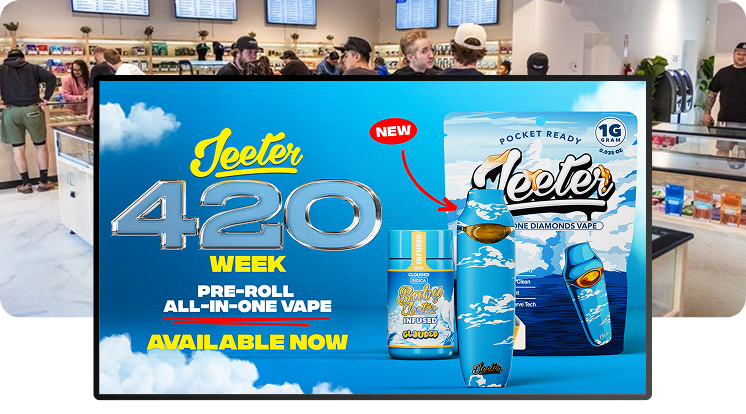
LIVE POS SYNC
Never sell what you don’t have.
Sold out? Off the menu before anyone asks for it. New price at the register? On the wall without anyone retyping a thing. Seed menus read your live POS inventory, so the most-read surface in your store is also the most accurate.

CAMPAIGN TOOLS
Menus built to sell.
Feature the brands you want to move, schedule the weekend promo weeks ahead, and run holiday campaigns across every screen without opening a design app. If someone on your team rebuilds menu graphics every morning, your signage is costing you payroll.

DESIGN, INCLUDED
A design team comes with the software.
Send us your fonts, colors, and logo — or a napkin sketch — and our designers build menu layouts that look like your brand, not a template. Design help is part of the subscription, not an invoice.
Trusted by dispensaries across the country, from MSOs to mom-and-pops












IN-STORE SCREEN RULES · NEW YORK
What you can show on screens in New York
OCM treats menus as advertisements but expressly allows prices, potency, and images on them, and allows promotional pricing on menus inside the premises. Since December 3, 2025, discounts, coupons, loyalty rewards, and bundles may be advertised as long as the price stays at or above market value (1.5 times wholesale) and tax is computed on the pre-discount price; giveaways and free or donated product remain prohibited. Screens may not appeal to under-21s, make medical or wellness claims, depict consumption or smoking or vaping imagery, or promote potency. The audience-composition test does not apply inside the premises, but the yellow-box warning and HOPEline requirements state no in-premises exemption, and OCM has not said whether they apply to menus. A screen in a window or door meant to be seen from outside is an outdoor sign limited to name, address, contact, directions, and licensed activity, and products may not be prominently displayed in storefront windows. Prices shown on a menu must be accompanied by a tax-inclusive total, and third-party brand signage in-store is capped as a retail advertising specialty.
Applies to: adult-use licensees under 9 NYCRR Part 129 and § 123.10; medical registered organizations are governed by Part 113, not covered here. Regulator: New York State Office of Cannabis Management (OCM).
- Menus are advertisements, and retailers may include product prices, potency, and images on them; promotional pricing may appear on menus displayed inside the premises. “Retailers may include product prices, potency, and images on menus.” (OCM Part 129 guidance)
- Since December 3, 2025, price reductions, discounts, coupons, points-based rewards, loyalty programs, and bundles may be advertised if they do not sell below market value and tax is computed on the pre-discount price. “such offers do not result in the sale of cannabis products below market value” (9 NYCRR § 129.3(a) (as amended))
- Market value is 1.5 times the wholesale price the retailer paid. (9 NYCRR § 128.1(p))
- Giveaways and free or donated cannabis may not be advertised; OCM guidance also bars buy-one-get-one-free and game-based promotions. “A licensee may not advertise through giveaways of adult-use cannabis products or "free" or "donated" cannabis products.” (9 NYCRR § 129.3(a))
- Visual advertisements must carry the warning statement, a rotating warning, and HOPEline information in a bright yellow text box; the rule states no in-premises exemption, and whether menus need the warnings is not stated in the rule or the guidance. “in a bright yellow text box so as to stand out from the surrounding advertising or advertisement” (9 NYCRR § 129.2(c)-(f))
- The 21+ audience-composition test does not apply to advertising viewable only inside the premises. “does not apply to advertising and advertisements that can only be viewed or heard solely from within the licensed or permitted premises” (9 NYCRR § 129.2(g))
- No content attractive to under-21s, no false or misleading content, no overconsumption; no medical, wellness, curative, or therapeutic claims; no depiction of consumption or smoking or vaping imagery; advertising may not promote product potency (listing it on a menu is allowed). (9 NYCRR § 129.2(b))
- A screen on a window or door meant to be seen from outside is an outdoor sign limited to name, address, contact, directions, and licensed activity; products may not be prominently displayed in a storefront window visible from the public thoroughfare. “any sign on any window or door of the brick-and-mortar premises not intended to be viewed from within the premises” (9 NYCRR § 128.1(z); § 129.4; § 123.10(g)(3))
- Prices must appear on any consumer-accessible menu, with a tax-inclusive total shown separately in similar size. “the total cost of the item which includes all taxes that would be paid by the consumer” (9 NYCRR § 123.10(m))
- In-store signs or ads for other licensees’ brands are allowed only as retail advertising specialties, capped at $200 per brand per licensee per year. (OCM Part 129 guidance; Part 124.1(i))
- Advertisements must carry the licensee’s name and license number; no general pre-approval, but special branding material needs OCM approval. "Advertisement" includes video and signs; no specific motion or video rule and no sign-count limit was found. (9 NYCRR § 129.2(k); § 128.1(b), (aa))
Potency on menus: No requirement to display potency on menus was found. OCM guidance allows potency on menus; § 129.2(b)(13) bars advertising that promotes product potency.
Where the rule is "keep it accurate," a menu that reads from the POS does the work: sold-out products drop off on their own and the price on the wall is the price at the register. Where the rule is about content, the layout and the campaign are yours to keep inside the lines.
Sources (5)
- 9 NYCRR Parts 128 and 129 (as amended December 3, 2025) — marketing and advertising: content, warnings, discounts and promotions, outdoor signs, definitions
- OCM Part 129 guidance — menus as advertisements; prices, potency, and images; promotional pricing in premises; third-party brand signs
- 9 NYCRR § 123.10 — retail operations: window displays; pricing and tax-inclusive totals on menus
- Cannabis Law § 86 — statutory advertising and marketing restrictions
- OCM PLMA overview — effective date and summary of the 2025 amendments
Summary for TV menus operators, reviewed against the primary sources on September 24, 2026. Not legal advice. Rules change; confirm with New York State Office of Cannabis Management (OCM) before a campaign goes live. Every state: in-store screen rules by state.
TV menus in New York: questions, answered
Which POS systems does Seed support in New York?
How fast do menu changes show up on screen?
Do I need to buy new TVs?
Can I show my deals and specials?
What does it cost?
How fast can my store go live?
What can a New York dispensary show on its in-store screens?
Ready for self-service too? See kiosks for New York dispensaries. Still building the store? Start with how to open a dispensary in New York.
GET STARTED
Put honest menus on the wall in New York.
Book a demo and we'll show your actual products on our screens — prices, deals, and stock straight from your POS.